


Key Takeaways:
CISA vs MBA in cybersecurity leadership depends on whether you want deep audit expertise or broader strategic leadership in security-driven business environments.
- CISA focuses on information systems audit, control, and assurance, making it ideal for risk and compliance leadership roles.
- MBA in Cybersecurity combines business management with security strategy, preparing professionals for executive decision-making roles.
- Both paths support cybersecurity leadership but differ in scope, depth, and career trajectory.
- Choosing between CISA and MBA depends on career goals, technical background, and leadership aspirations.
“Cybersecurity leadership is not just about protecting systems. It is about managing risk, enabling trust, and aligning security with business growth.”
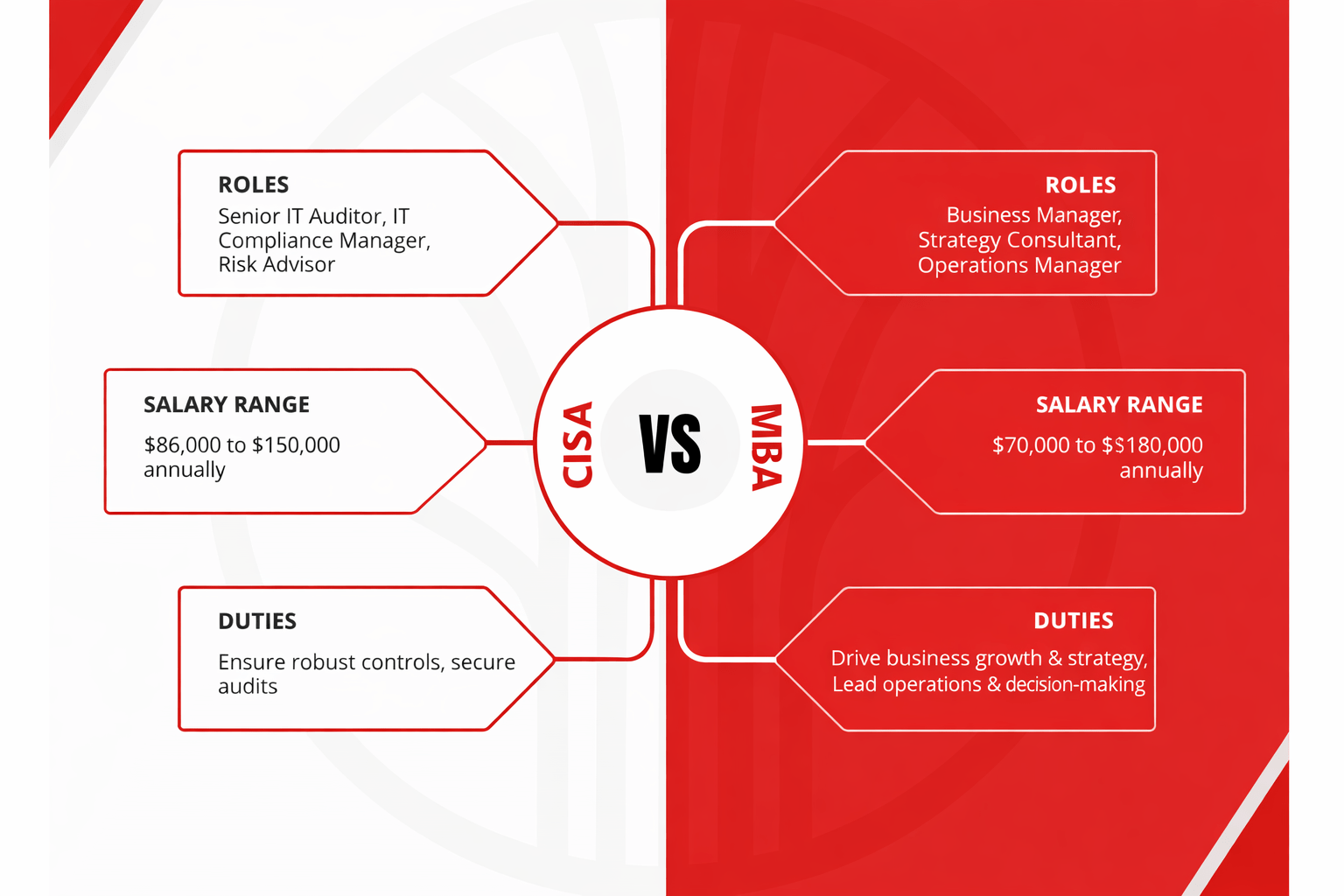
CISA vs MBA in Cybersecurity Leadership
As cybersecurity becomes a core business priority, organizations need leaders who can manage risk, ensure compliance, and drive secure digital growth. The demand for cybersecurity leadership roles is increasing across industries, from finance to healthcare and technology.
Professionals aiming for leadership positions often face a key decision: whether to pursue CISA certification or an MBA in Cybersecurity. Both paths offer strong career value, but they serve different purposes and prepare individuals for distinct roles within the cybersecurity ecosystem.
Understanding the differences between CISA and MBA helps professionals choose the right path based on their long-term career goals.
What is CISA in the Context of Cybersecurity Leadership?
CISA (Certified Information Systems Auditor) is a globally recognized certification focused on information systems auditing, control, and assurance. It is designed for professionals who want to specialize in evaluating security systems, managing risks, and ensuring compliance with standards.
In cybersecurity leadership, CISA-certified professionals play a critical role in governance, risk management, and audit functions.
Key capabilities developed:
- Information systems auditing and control
- Risk assessment and mitigation
- Governance and compliance frameworks
- Security policy evaluation and enforcement
- Internal and external audit management
CISA is highly valuable for roles that require deep expertise in security controls and regulatory environments.
What is an MBA in Cybersecurity Leadership?
An MBA in Cybersecurity Leadership combines business management principles with cybersecurity strategy. It is designed for professionals who want to move into leadership roles where decision-making, strategy, and business alignment are critical.
Unlike CISA, which is certification-focused, an MBA provides a broader academic and strategic perspective.
Key capabilities developed:
- Business strategy and leadership
- Cybersecurity program management
- Financial and operational decision-making
- Organizational risk management
- Strategic alignment of security with business goals
This path is ideal for professionals aiming for executive roles such as Chief Information Security Officer (CISO) or cybersecurity director.
Key Differences: CISA vs MBA in Cybersecurity
- Focus Area: CISA emphasizes audit, control, and compliance, while MBA focuses on business leadership and strategy
- Depth vs Breadth: CISA offers deep technical and audit expertise, MBA provides broader business and management knowledge
- Career Path: CISA leads to audit, risk, and compliance roles; MBA leads to leadership and executive roles
- Learning Approach: CISA is certification-based and exam-driven; MBA is degree-based with comprehensive coursework
- Time Investment: CISA can be completed faster; MBA requires a longer academic commitment
Both paths are valuable but serve different professional needs.
Why Choose CISA for Cybersecurity Leadership
CISA is the right choice for professionals who want to build expertise in security governance, audit, and compliance.
- Strong demand in audit, risk, and assurance roles
- Globally recognized certification in cybersecurity governance
- Ideal for roles like IT auditor, risk manager, and compliance leader
- Enhances credibility in regulatory and enterprise environments
- Focuses on structured frameworks and control mechanisms
CISA-certified leaders ensure that organizations remain secure, compliant, and audit-ready.
Why Choose MBA for Cybersecurity Leadership
An MBA in Cybersecurity is suitable for professionals aiming to lead security initiatives at a strategic level.
- Prepares for executive and leadership roles in cybersecurity
- Combines business knowledge with security expertise
- Enhances decision-making and strategic thinking
- Suitable for roles like CISO, security director, and transformation leader
- Focuses on aligning cybersecurity with business growth
MBA graduates drive cybersecurity as a business enabler rather than just a technical function.
Role of CISA and MBA in Cybersecurity Leadership Success
Cybersecurity leadership requires both technical understanding and strategic vision. CISA and MBA contribute differently to this goal.
- CISA ensures strong governance, risk control, and compliance
- MBA drives strategic alignment and business-focused decision-making
- CISA supports audit readiness and regulatory requirements
- MBA enables leadership across cross-functional teams
- Combining both can create a highly effective cybersecurity leader
Organizations benefit from leaders who can balance control with innovation.
Key Skills Built Through Each Path
CISA Skills:
- Audit and compliance expertise
- Risk assessment and control
- Security governance frameworks
- Attention to detail and analytical thinking
- Regulatory and policy understanding
MBA Cybersecurity Skills:
- Strategic leadership and decision-making
- Business and financial acumen
- Organizational management
- Communication and stakeholder influence
- Innovation and transformation mindset
Both skill sets are critical but applied in different leadership contexts.
Keep in Mind
- Cybersecurity leadership requires both technical and strategic capabilities
- CISA is ideal for specialization in audit and governance
- MBA is better for broader leadership and executive roles
- Career goals should guide the choice between certification and degree
- Combining both paths can significantly enhance leadership potential
How to Choose Between CISA and MBA
Choosing between CISA and MBA depends on your current role and future aspirations.
- Choose CISA if you want to specialize in audit, risk, and compliance
- Choose MBA if you aim for executive leadership in cybersecurity
- Consider experience level and time commitment before deciding
- Evaluate whether you need depth (CISA) or breadth (MBA)
- Long-term goals should align with your chosen path
In many cases, professionals pursue CISA first and later complement it with an MBA for broader leadership growth.
Keep in Mind
- There is no one-size-fits-all path in cybersecurity leadership
- Industry demand exists for both audit experts and strategic leaders
- Continuous learning is essential in cybersecurity careers
- Practical experience enhances both CISA and MBA outcomes
- Leadership success depends on applying knowledge in real-world scenarios
Frequently Asked Questions (FAQs)
Which is better for cybersecurity leadership, CISA or MBA?
Both are valuable. CISA is better for audit and compliance roles, while MBA is ideal for strategic and executive leadership positions.
Can I pursue both CISA and MBA?
Yes, many professionals combine both to gain technical depth and strategic leadership skills.
Is CISA enough for leadership roles?
CISA is sufficient for leadership in audit, risk, and compliance, but broader roles may require business knowledge.
Does an MBA help in becoming a CISO?
Yes, an MBA in Cybersecurity is highly beneficial for CISO roles as it focuses on strategy and leadership.
Which has better career growth, CISA or MBA?
Both offer strong growth, but in different paths. CISA leads to specialized roles, while MBA opens broader leadership opportunities.