

Recommendations for IT Certifications That Offer High Salary Potential?
Security governance and audit certifications, cloud architecture certifications, and IT project leadership certifications are among the top-grossing certifications in the US and Canada. Depending on the role, location, experience, and industry, experienced specialists can command six-figure salaries for their job duties through certifications like CISA, CISSP, CISM, AWS/Azure cloud, or PMP.
“High salary potential” is not determined by the certification name alone. The value of a credential depends on the demand of that skill, the lack of trained employees and also if the credential will help you pivot into being a specialist or a leader. For example, US information security analysts had a median annual wage of $124,910 in May 2024, while computer and information systems managers had a median of $171,200. (Bureau of Labor Statistics)
In this guide you will find an overview of the top-paying IT certifications, what they support, the experience level required, and how to determine which IT certification will pay off more for you.
TL;DR: Which IT Certifications Pay the Most?
The strongest salary opportunities in 2026 are concentrated in three areas:
- Security governance and audit: CISA, CISSP, and CISM
- Cloud architecture: AWS Solutions Architect and Microsoft Azure Solutions Architect
- Project and program leadership: PMP and, for more experienced professionals, PgMP
CISA is especially beneficial for mid-career professionals who are transitioning to roles in IT audit, risk, compliance, governance, and security assurance. ISACA currently provides an average salary of over $149,000 per year for individuals with CISA certification and ISC2’s median CISSP salary is $150,000 per year for North American individuals. These are only estimates based on surveys and are not guaranteed compensation.
CISA can provide a solid mix of job relevance and earning potential for current system, network, security control, compliance, or audit professionals.
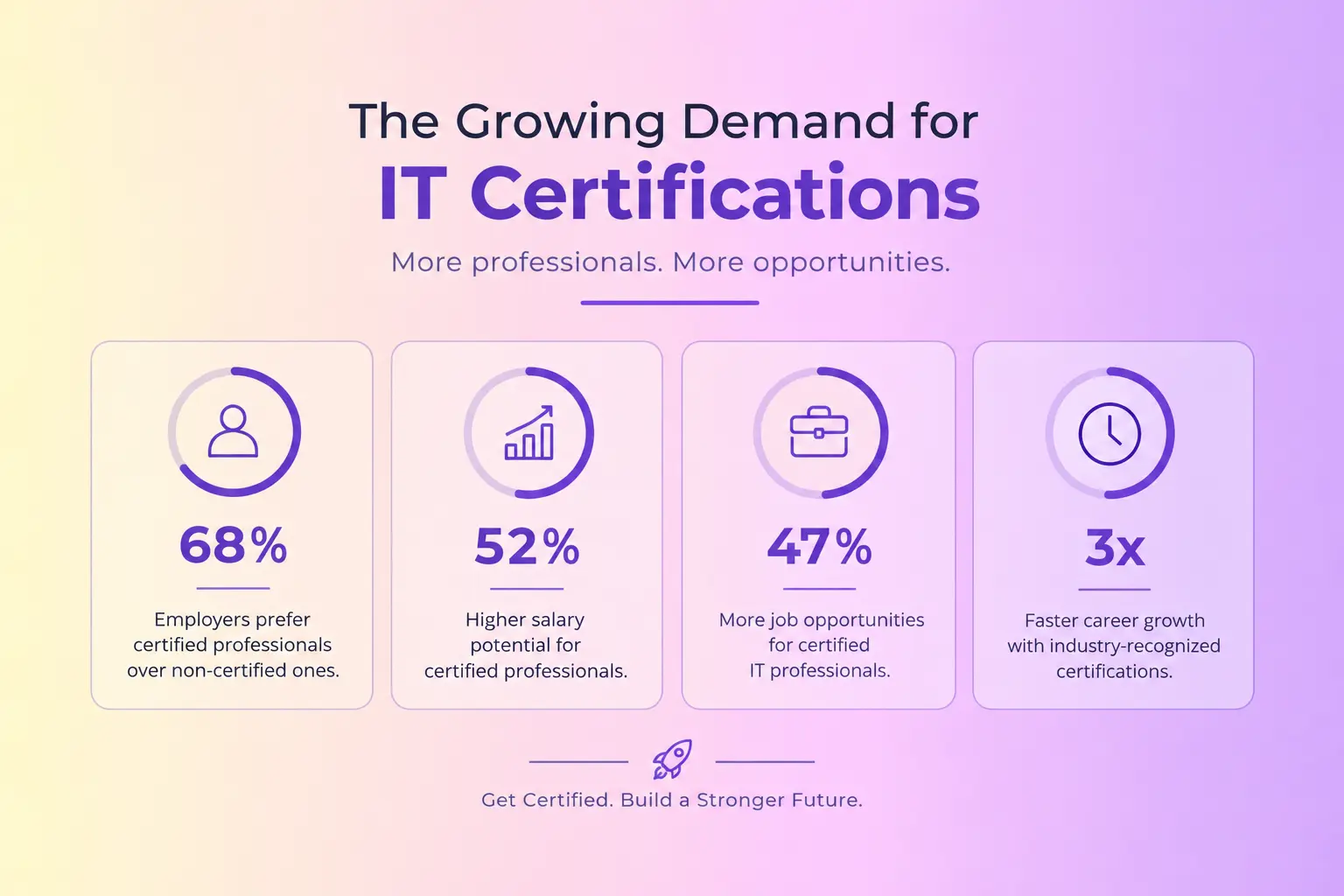
How Salary Potential Actually Breaks Down by Certification
The most profitable IT certifications are typically the ones that relate directly to a difficult-to-fill business need.
Firstly, there are skills in governance and accountability that have a more specific purpose. Every organization working in heavily regulated sectors such as financial services, healthcare, government and other service providers need to constantly handle IT controls, risk management, audit, privacy issues and regulations. This opens up opportunities for professionals who can link technical systems to business and regulatory needs.
Secondly, there is continuing linkage between cloud skills and technical hires. Cloud workloads keep proliferating on AWS, Microsoft Azure, and other clouds. These cloud architecture certifications can help you complement rather than upend a current job path in infrastructure and networking, security, or DevOps.
Third, a strong leadership resume broadens the job search. PMP is not restricted to IT but applies across industries — technology, consulting, finance, healthcare, manufacturing, construction, government — anywhere project management skills come in handy. In May 2024, the median annual salary among project management specialists in the United States was $100,750, and the top 10% of the field earned over $165,790. (Bureau of Labor Statistics)
What matters is that salary rankings by certification should not just be popularity contests. A credential is “high value monetarily” when it enables an individual to obtain a job that has high demand, a higher level of responsibility, and/or specialized skills.
Highest-Paying IT Certifications Ranked
The following list includes certifications that experienced IT professionals have found to lead to lucrative careers, rather than certifications for entry-level positions.
1. CISA (Certified Information Systems Auditor)
CISA is among the best IT audit, governance, risk, controls, and compliance certifications for professionals.
Issued by ISACA, it is designed to validate knowledge in information systems auditing, governance, risk management, controls and security.
This is especially applicable to IT professionals looking to transition from technical IT into roles involving business risk assessment and system evaluation.
Common CISA-certified positions include:
- IT Auditor
- IT Risk Analyst
- IT Compliance Manager
- Information Systems Auditor
- Security Governance Lead
- IT Controls Specialist
- Risk and Assurance Manager
- GRC Consultant
The average salary for a CISA holder is currently over $149,000 per year according to ISACA. This is the certification body’s average and is not to be construed as a guaranteed salary for someone newly certified. Experience, location, industry, and job level continue to play a major role.
CISA also has an experience requirement. For certification, candidates need at least five years of professional work experience in information systems auditing, control, or security; other education or experience may be applied to reduce this number. Candidates may sit the exam prior to obtaining experience and work toward the required years afterward.
CISA Certification Training
If you are a professional targeting the CISA exam, the CISA certification training can be beneficial in providing structure to the audit, governance, controls and security concepts you’ll need to study. The CISA program offered by ZOC Learnings consists of concepts and scenarios related to IT audit and governance, preparation for the rigorous testing, learning materials, and mock tests.
Choosing the right CISA training and certification methodology is vital, and depends on your experience and learning style. Blended or self-paced learning might be a better option for working professionals who wish to prepare for their exam while maintaining a full-time job.
Explore CISA Certification Training from ZOC Learnings
2. CISSP (Certified Information Systems Security Professional)
CISSP is a good option for seasoned cybersecurity professionals seeking a career in technical or security leadership.
The certification, administered by ISC2, covers eight security domains, including security and risk management, asset security, security architecture, network security, identity and access management, security assessment, security operations, and software development security.
Common roles include:
- Security Manager
- Security Architect
- Cybersecurity Consultant
- Security Director
- Information Security Manager
- Security Engineer
- CISO-track roles
ISC2’s latest salary report shows a $150,000 median salary for CISSPs in North America and a $127,000 median salary worldwide. These are survey figures and not guaranteed salaries.
To qualify for CISSP, candidates need a minimum of five years of full-time work experience in at least two of the eight domains. Up to one year of the required experience can be waived with a qualifying degree or approved credential. Professionals who pass the exam but don’t yet meet the experience requirement can register as an Associate of ISC2 until it’s fulfilled.
CISSP is most useful for people who already have substantial cybersecurity experience to draw from. For someone coming from IT audit, controls, or governance, CISA may provide a more direct route into the desired career.
3. CISM (Certified Information Security Manager)
CISM is especially beneficial for those moving into information security governance and leadership.
Like CISA, the CISM designation is also offered by ISACA. It focuses on information security governance, risk management, security programs, and incident management. Where CISSP is more knowledge-based and covers the broad technical security landscape, CISM is more skills-oriented and focused on the enterprise security function.
Typical roles include:
- Information Security Manager
- Security Governance Manager
- Security Program Manager
- Risk Manager
- Security Consultant
- CISO-track professional
According to ISACA, the average annual salary for CISM holders is currently $149K or more. Again, this is an average result, not guaranteed income.
CISM is particularly appropriate if your objective is to run security programs rather than spend most of your time on technical implementation.
4. Cloud Certifications: AWS Solutions Architect and Azure Solutions Architect
Cloud architecture certifications can be among the best IT certifications for salary growth when paired with hands-on cloud experience.
The majority of enterprise cloud environments run on AWS and Microsoft Azure, and demand exists for anyone capable of designing, securing, deploying, and optimizing cloud infrastructure.
Relevant roles include:
- Cloud Architect
- Solutions Architect
- Cloud Engineer
- DevOps Lead
- Cloud Security Engineer
- Infrastructure Architect
- Cloud Consultant
Certification alone isn’t enough to establish someone as a senior cloud architect. Employers usually look for experience with networking, identity, infrastructure as code, security, containers, databases, monitoring, and other cloud-native services.
The salary data shows earnings potential for the wider technical roles on this pathway. The median salary for software developers was $133,080, compared to $130,390 for computer network architects. Professionals moving into management see a substantially higher median, with computer and information systems managers at $171,200.
According to AWS, its Solutions Architect credential certifies the ability to design cost-effective, high-performance, secure, and resilient architectures on AWS.
From a network or systems administrator standpoint, a cloud certification may make sense. Cloud security could also be one specialization path for a security professional.
5. PMP (Project Management Professional)
Project management skills transcend industries, which makes PMP certifications one of the most portable and high-paying credentials.
PMP validates project leadership knowledge across predictive, agile, and hybrid project methods.
Typical roles include:
- IT Project Manager
- Technical Project Manager
- Program Manager
- Delivery Manager
- Project Director
- Technology Program Lead
As of May 2024, the US Bureau of Labor Statistics reported that project management specialists made a median annual wage of $100,750, with the highest-paid 10% earning more than $165,790.
To qualify as a PMP, candidates need a combination of education and project leadership experience. Under PMI’s 2026 requirements, candidates with a bachelor’s degree typically need 36 months of project leadership experience, while candidates with a secondary degree typically need 60 months. (Project Management Institute Exam Outline)
For IT professionals, pairing PMP with a tech background makes it even more powerful — a PMP-credentialed infrastructure engineer doesn’t have to give up years of technical experience to pursue a technology project leadership role.
IT Certification Salary Comparison
The salary information below is indicative and not a guarantee. It draws on certification salary data from professional association surveys and US occupational salary data, since there is no single salary database focused solely on certifications.
| Certification | Focus Area | Typical Roles | Experience Required | Salary Indicator | Relative Demand |
| CISA | IT audit & governance | IT Auditor, Compliance Manager, Risk Analyst | 5 years, with possible waivers | ISACA reports $149K+ average | High |
| CISSP | Broad cybersecurity | Security Manager, Architect, Security Consultant | 5 years | $150K North America median | High |
| CISM | Security management & governance | Security Manager, Risk Manager, CISO-track | 5 years, with waivers | ISACA reports $149K+ average | High |
| AWS/Azure Solutions Architect | Cloud infrastructure | Cloud Architect, Solutions Architect, DevOps Lead | No formal certification experience requirement | Related architecture roles can exceed $130K median in the US | Very high |
| PMP | Project leadership | IT PM, Program Manager, Delivery Manager | 3–5 years depending on education | $100,750 US median for project management specialists | High |
CISA’s appeal comes down to its demand-to-specialization ratio: it focuses on a specific professional field — IT audit, controls, risk, and governance — rather than the whole of cybersecurity.
CISSP offers broader cybersecurity coverage and stronger recognition for senior roles, cloud certifications suit those wanting to stay on a technical career path, and PMP is the most portable option for those interested in project or program leadership.
Where to Get CISA Certification Training in Canada
Canadian candidates study the same material and pursue the same professional credential as candidates around the world in order to obtain CISA. Training format, delivery method, availability, and local support can vary.
The credential may be of special interest to professionals seeking CISA certification Canada options in industries where IT controls, risk, security, privacy, and regulatory compliance are central to the business — banking, insurance, healthcare, government, and large enterprises among them.
Canadian students can access ZOC Learnings for CISA training through various modes, including online learning, study materials, mock tests, study support, and career guidance — designed for IT auditors, risk managers, compliance officers, cybersecurity professionals, IT managers, and systems administrators focused mainly on Canada.
Training is not the same as obtaining the ISACA certification. Candidates should distinguish between taking a training course and meeting ISACA’s criteria to become a CISA.
Explore ZOC Learnings’ CISA Training & Certification Course in Canada
Thinking about a CISA career to help get more pay? Explore ZOC Learnings’ CISA exam preparation and certification training for working IT professionals in the United States and Canada, with flexible learning options.
Certification vs. Salary: Is It Worth the Investment?
Having a certificate doesn’t always mean the top-ranked pay on a chart is the best one for you.
Ask three questions before spending money and months preparing for an exam.
1. Does the certification match your current career?
If you’re moving from systems administrator to cloud engineer, AWS or Azure naturally makes sense. If you already work with compliance, risk, controls, or audits, CISA may offer a much shorter path to value.
Mismatches can happen when a certification is chosen simply because it’s on a salary list, without relevance to your actual field.
2. How competitive is the market?
A popular certification can be beneficial, but there are also many professionals holding the same one.
The aim should be to pair a certification with a rarer skill. CISA plus IT audit experience is a different profile than CISA alone. Likewise, an Azure certification plus networking, security, automation, and infrastructure experience is more valuable than the certification by itself.
3. Will your employer help pay for it?
Some employers have career pathways in place, reimburse exams, offer professional development funds, or provide paid study time.
When your employer recognizes the certification and gives you opportunities to apply the new skills, it’s a much stronger investment.
Which Certification Offers the Best ROI?
Consider these scenarios:
A systems administrator considering CISA:
CISA makes sense if the administrator regularly works with controls, audits, compliance, or access management and wants to move into IT risk or audit.
A systems administrator considering AWS:
If you’re working with cloud infrastructure, DevOps, or solutions architecture, AWS or Azure is probably a better fit.
A security analyst considering CISSP:
CISSP can be a good next step once the professional has accumulated enough field experience to qualify for the exam.
An IT professional moving into leadership:
PMP may offer broader value if the person increasingly manages budgets, timelines, stakeholders, vendors, and cross-functional technology projects.
The ideal certification is the one that reinforces the career trajectory you’re already on.
Why CISA Can Be a Strong Salary-to-Effort Choice
CISA sits at the crossroads of technology, risk, governance, and business, which makes it a strong fit for mid-career professionals.
The certification isn’t limited to traditional auditors — it also applies to IT controls, security assurance, compliance, risk management, and governance professionals, and is especially valuable for those with technical expertise who want to move closer to decision-making and business risk.
Demand for security skills is also growing in the wider market. The US Bureau of Labor Statistics projects that the number of information security analysts will increase by 29% between 2024 and 2034, well above the average for all occupations.
Meanwhile, ISC2’s 2025 workforce study found that cybersecurity teams continue to report significant skills shortages, even as organizations face budget pressure.
While CISA doesn’t guarantee a higher salary, it allows experienced individuals to move into positions that combine IT, governance, and risk management skills.
Conclusion
The most lucrative IT certifications in 2026 focus on security governance and audit, cybersecurity leadership, cloud architecture, and project management. Backed by relevant professional experience, certifications like CISA, CISSP, CISM, AWS/Azure, and PMP can all help boost income.
It’s not just about how many people hold a certification — earning potential depends on demand for the underlying skill, whether it’s used in a senior role, your experience level, location, industry, and how well you can apply the certification on the job.
CISA resonates with professionals already in or adjacent to IT audit, risk, compliance, governance, and security. Its mix of business and technical knowledge makes it a solid choice for US and Canadian professionals aiming for elevated responsibility.
Looking for a certification with high earning potential? Learn about ZOC Learnings’ CISA training and certification course, and select the mode of preparation that fits you best.
FAQ
What is the highest paying IT certification?
There is no single highest-paying IT certification because salaries depend on the role, industry, experience, and location. CISA, CISSP, CISM, cloud architecture certifications, and PMP can all support high-paying careers. CISSP holders report a North American median salary of $150,000, while ISACA reports $149,000+ average salaries for CISA and CISM holders.
Is CISA a good certification for salary growth?
Yes. CISA can support salary growth for professionals moving into IT audit, risk, governance, controls, and compliance roles. ISACA currently reports an average annual salary above $149,000 for CISA holders, although actual compensation varies by experience, location, industry, and job level.
How much does CISA certification training cost?
CISA training costs vary by provider, delivery format, location, and whether study materials or additional services are included. Candidates should also account separately for ISACA examination and certification fees. Compare instructor-led, blended, and self-paced options before choosing a CISA training and certification program.
Is CISA certification recognized in Canada?
Yes. CISA is an internationally recognized certification administered by ISACA, and Canadian professionals can pursue the same credential as candidates in other countries. It can be relevant to IT audit, risk, governance, security, and compliance roles across Canadian organizations.
Do I need a certification or a degree for a high-paying IT career?
Neither a certification nor a degree guarantees a high salary. Certifications such as CISA, CISSP, and PMP can strengthen an experienced professional’s qualifications, while degrees may be important for certain employers and senior roles. The strongest candidates typically combine education, practical experience, specialized skills, and relevant certifications.