

Which IT Certification Should I Choose For Advancing in Cybersecurity?
There is no single best IT certification for cybersecurity because the right choice depends on your career stage and specialization. CompTIA Security+ is a good foundation, CEH or OSCP may be suitable for technical field based jobs, and CISSP or CISM jobs may be better suited for senior security, governance and management jobs.
The difficult part is selecting a certification that corresponds to your specific professional ambition not just collecting certificates. This guide offers a side-by-side overview of the big cybersecurity certifications based on their level and a breakdown of what to keep in mind when certifications alone aren’t enough.
TL;DR:
Which Cybersecurity Certification Should You Choose?
There’s no single “best” cybersecurity certification — the right one depends on your career stage:
- New to IT/security: CompTIA Security+ (or Network+ first, if you lack networking basics)
- Technical/offensive security track: CEH (foundational) or OSCP (hands-on, more respected)
- Cloud security track: CCSP
- Senior security leadership/architecture: CISSP (requires ~5 years experience)
- Security management, governance, risk, CISO-track: CISM
- IT audit, compliance, assurance: CISA
- Already have CISSP/CISM + years of leadership experience, aiming for CISO/VP/strategic roles: consider a doctorate in cybersecurity instead of another certification
No certification is universally “highest-paying.” Pay depends on role, experience, industry, and location — not the credential alone.
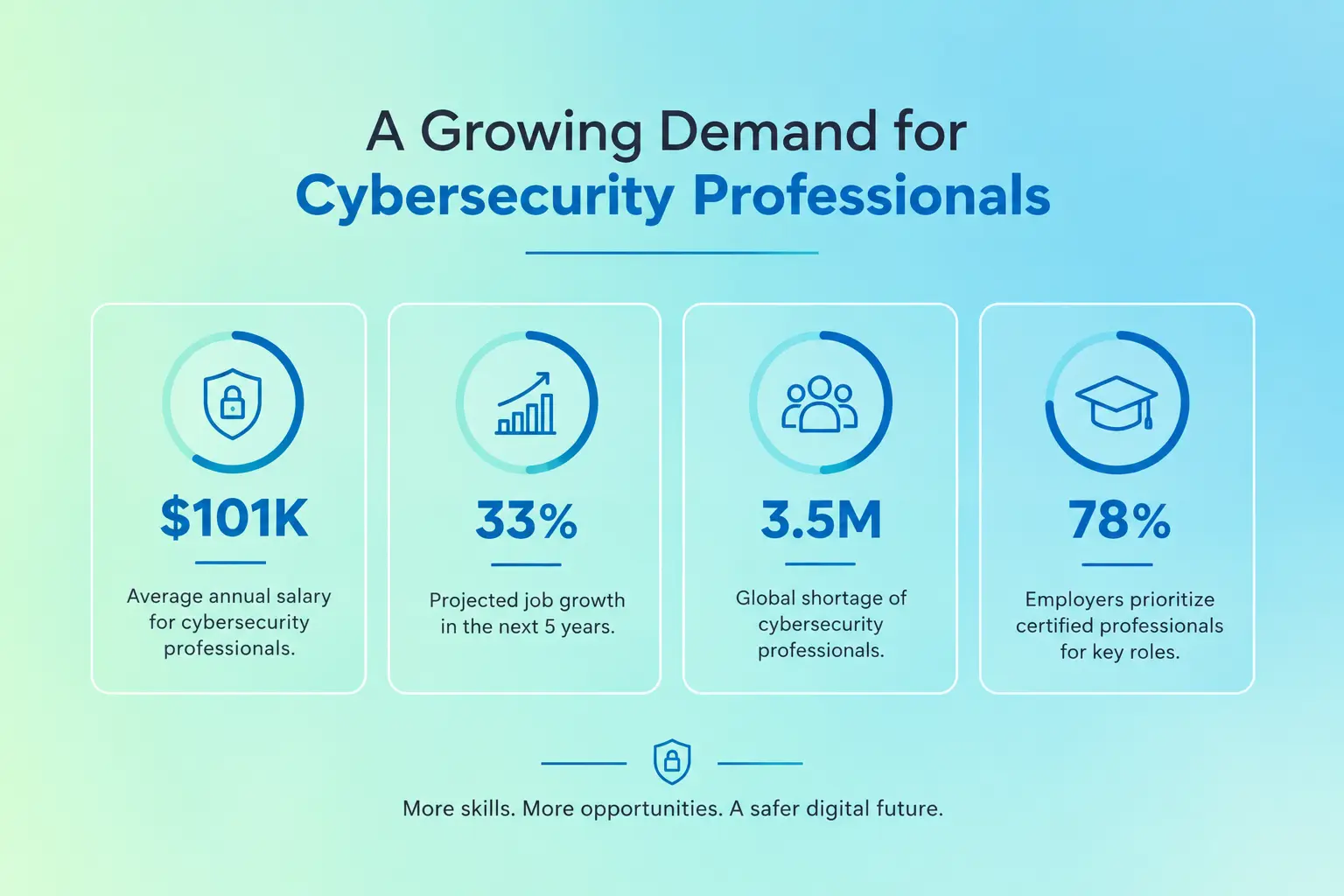
Cybersecurity Certifications by Career Stage
The right certification will vary according to your future career. Entry-level certifications provide the essential knowledge, technical certifications certify specialist skills, and leadership certifications build and validate the skills to lead security programs.
Entry-Level Certifications
For those who are not yet into the world of cybersecurity, emphasize foundational levels of certification instead of advanced ones.
One of the most popular entry points is CompTIA Security+ Certification. It’s vendor agnostic, includes threats, vulnerabilities, security architecture, identity management, risk management and incident response. It may be beneficial for those interested in becoming a junior security analyst, a SOC analyst, or a security IT support specialist.
However, if you have not yet begun to develop general IT skills, then CompTIA Network+ may provide a beneficial precursor to Security+. Networking is relevant to cybersecurity because a lot of cybersecurity issues include traffic, protocols, infrastructure, access control, and network architecture.
One is the SSCP (Systems Security Certified Practitioner) from (ISC)². It emphasizes how security functions can be put into practice and managed, and may be applicable for IT professionals with some hands-on experience.
Study time for the various certifications and training providers, exam versions and prior knowledge will differ. Depending on a candidate’s background and experience with networking and systems, some preparation for several weeks may be necessary, while others new to IT may require several months of focused preparation.
These certifications are a starting point, not a career ceiling. After gaining foundational knowledge and some hands-on experience, your next certification should be in the security specialty in which you are interested.
Mid-Career and Technical Specialization Certifications
Technology professionals tend to receive better benefits from a specialist certification than from obtaining other preliminary qualifications.
The Certified Ethical Hacker (CEH) focuses on ethical hacking concepts and methodology. Offensive security, vulnerability assessment, and penetration testing may be applicable to it.
A different perception is held about the Offensive Security Certified Professional (OSCP), as it is about hands-on work on offensive-security skills. Candidates need to be able to find and take advantage of vulnerabilities beyond simple multiple choice knowledge in a controlled environment.
That distinction matters. If a certification is based on practical performance, it can be more convincing evidence of technical skills than another credential based on knowledge recollection.
The Certified Cloud Security Professional (CCSP) is another option for professionals entering the cloud world. It is based on cloud security concepts, architecture, operations, risk and compliance.
The right choice depends on your target role. An offensive security certification might appeal to a penetration tester, and a cloud certification might more suit the needs of someone transitioning from a cloud job to security.
Management and Leadership Certifications
One of the elite certifications for seasoned cybersecurity practitioners is the CISSP (Certified Information Systems Security Professional). It covers areas such as security and risk management, asset security, security architecture, network security, identity and access management, security assessment and security operations.
CISM (Certified Information Security Manager), presented by ISACA, has a more management, governance, risk, and information-security-program perspective. It’s especially for those on a security-management or CISO-track pathway.
The Certified Information Systems Auditor (CISA) is yet another option. It is dedicated to auditing, controls, assurance, governance and information systems risk. It is particularly applicable to IT audit, compliance, and assurance roles.
The CISSP generally requires 5 years of relevant work experience in two of the eight CISSP domains; some education/credential combinations could meet part of the experience requirement. Before starting to chart out a certification pathway, always make sure to understand the current requirements imposed by the issuing organization.
CISSP vs CISM vs CISA
These three certifications are frequently compared once they all start to show up on the resumes of experienced security professionals. However, they serve different career goals.
| Factor | CISSP | CISM | CISA |
| Focus | Broad cybersecurity knowledge and security leadership | Information security management, governance and risk | IT audit, controls and assurance |
| Best for | Security managers, architects and senior security professionals | Security managers, risk leaders and CISO-track professionals | IT auditors, compliance and assurance leaders |
| Issuing body | (ISC)² | ISACA | ISACA |
| Experience | Typically 5 years of relevant experience | Typically 5 years of relevant experience, with applicable waivers | Typically 5 years of relevant experience, with applicable waivers |
| Typical career direction | Senior security and architecture leadership | Security management and governance | Audit, compliance and assurance leadership |
CISSP is the broadest of the three. It’s valuable for someone who wants a qualification that validates competence across several different facets of cybersecurity in order to build a path forward in a senior security career.
CISM has a management focus. Its emphasis might be closer to what you’re doing if you have long-term aspirations in roles such as security governance, risk management, program leadership, or a CISO-track position.
CISA is best suited to a career that focuses on audit, assurance, control, compliance or technology risk.
At some point many senior professionals end up with more than one of these credentials. But with certifications like CISSP and CISM, another certification can’t have the same career impact as it did when the individual first earned it.
What Is the Highest-Paying Cybersecurity Certification?
No certificate will guarantee the best-paying jobs. Pay varies depending on job, experience, industry, location, compensation requirements, technical expertise, managerial position, and employer.
Nevertheless, certifications aimed at leadership and security management roles, like CISSP and CISM, are offered at the senior level and can aid advancement into higher-paying positions within the security field.
Technical qualifications also can carry solid value. An offensive-security professional with strong demonstrated skills, for instance, might be paid competitively based on their ability — not just their credential.
The main thing is that the highest-paid cybersecurity certificate rarely holds much weight by itself. A certification is more worthwhile if it enhances a desired skill set that also has strong demand and a defined career path.
For instance, an entry-level employee might benefit more from landing their first security position with Security+, while an employee with more years of experience can benefit more from advancing into a security leadership position with CISSP. Direct salary comparisons, then, would be misleading.
Your Cybersecurity Certification Roadmap
A good cybersecurity certification roadmap should evolve as you evolve — not exist as a checklist of exams.
Stage 1: Build IT fundamentals
If you are new to IT, start with networking, operating systems, cloud fundamentals, and basic security concepts. Network+ can be useful for candidates who need stronger networking knowledge.
Stage 2: Establish cybersecurity fundamentals
Security+ is a logical option for developing broad, vendor-neutral cybersecurity knowledge. Combine the certification with labs, projects, and practical experience.
Stage 3: Choose a specialization
Decide whether you want to move toward penetration testing, cloud security, security operations, incident response, governance, or another specialty. Technical professionals can consider credentials such as CEH, OSCP, or CCSP depending on their chosen direction.
Stage 4: Develop senior-level capability
As your responsibilities expand, consider certifications such as CISSP, CISM, or CISA based on whether your career is moving toward broad security leadership, management and governance, or audit and assurance.
Stage 5: Look beyond certifications
At senior levels, the next career challenge may not be proving that you know more security concepts. It may be demonstrating that you can develop strategy, manage organizational risk, influence executives, lead transformation, and contribute to security decisions at scale. That is where advanced education can become worth considering.
When Certifications Stop Moving the Needle
Certifications validate knowledge and, for some, hands-on skills. They don’t necessarily mean a person can carry out full security management for an organization.
The difference matters for career advancement into roles like security director, CISO, VP of Security, or strategic advisory positions.
It’s possible for a senior professional to hold Security+, CEH, CISSP, CISM, and years of experience. At this stage, another general qualification may yield only slight gains in differentiation.
Senior security managers’ expectations are growing as well. The need for leaders who can navigate regulatory requirements, articulate cyber risk to executives and boards, guide budgets successfully, and balance security and business goals while making decisions in unclear situations has never been greater.
While certification can help that growth, it isn’t a replacement for leadership experience.
There is another option for advanced learning for professionals who have come this far — one that builds strategic and research skills as well.
Beyond Certifications Is a Doctorate in Cybersecurity Worth It?
A doctorate in cybersecurity is not necessary for most cybersecurity careers. However, it can offer something more to a seasoned professional than another certification.
What a Doctorate Adds That Certifications Don’t
Certifications typically verify knowledge or skills to a specified professional level. A professional doctorate focuses more broadly on research, analysis, strategic thinking, and problem-solving skills.
That distinction means doctoral education isn’t as useful for those starting out in cybersecurity as it is for a senior professional.
If you are a CISO, security director, GRC manager, senior consultant, or veteran practitioner in the field, a doctorate might be relevant if you’re looking to build research skills for uncovering complex security issues and creating an organization-wide strategy.
It shouldn’t be seen as “better” than certifications. Often, the best profile mixes professional experience, relevant certifications, leadership accomplishments, and advanced academic work.
Can You Get a Doctorate in Cybersecurity Online?
Yes. An online doctorate in cyber security is a doctoral program a professional can enroll in while continuing to work full-time. If you have a few years of experience under your belt in security, online doctoral study may be more practical.
The first thing to check when looking at an online doctoral program is whether it’s accredited. The curriculum, faculty, research requirements, program structure, delivery format, total cost, and recognition of the qualification in the country where you intend to use it should also be reviewed.
These factors are especially critical for professionals in the US and Canada, as recognition and accreditation can impact how a person’s academic credential is regarded by employers and other institutions.
Pursuing your doctorate in cybersecurity online is possible through ZOC Learnings’ programme for working professionals. Individuals interested in the program are advised to independently check its accreditation, degree-granting institution, degree recognition, course of study, and applicable requirements for their intended career or academic application.
Are you currently a CISSP or CISM holder looking to advance your career toward CISO or director? If you’re interested in continuing your education and research career in cybersecurity, consider exploring ZOC Learnings’ online doctorate program in cyber security to assess whether it’s a good fit.
Certifications vs. a Doctorate Which Path Fits You Right Now?
Not every professional faces a choice between certification and a doctoral program. They’re typically aimed at different levels of career growth.
Stick With Certifications If…
- You are an early- or mid-career professional who needs foundational cybersecurity knowledge.
- You are seeking an in-depth technical role in SOC, cloud security, or penetration testing.
- You need a credential within weeks to months.
- You are still developing real-world security skills.
- A specific certification is required by your employer or a role you’re targeting.
A specialist who doesn’t intend to pursue a doctoral program would be better served developing technical abilities and earning a relevant credential rather than diving straight into doctoral study.
Consider a Doctorate If…
- You already have senior qualifications like CISSP or CISM.
- You have substantial cybersecurity leadership experience.
- Your goal is to become CISO, VP of Security, or hold a strategic advisory position.
- You wish to build research and strategic skills.
- You have an interest in cybersecurity research or solving complex organizational security problems.
- You need an academic structure that allows flexibility around a career.
Suppose someone has been a security director for a number of years and is plateauing in their career, with a CISSP and CISM and years of experience. If the next role calls for a higher level of strategic, research, or executive ability, the gap may be better addressed by advanced education than by another certification.
It isn’t a question of whether a doctorate is more sought-after than a certificate. It’s whether the credential closes the capability gap between your current role and your next one.
How to Choose the Right Certification
Before paying for an exam, ask five questions:
- What job do I want next? Start with the job description rather than the certification catalog. Identify the credentials that repeatedly appear in roles you want.
- Am I technical or management-oriented? Hands-on certifications are useful for technical professionals. Professionals on a management track would benefit more from credentials such as CISSP, CISM, or other governance-related credentials.
- Do I meet the experience requirements? Advanced certifications may require significant experience. Always confirm the conditions before registering for an exam.
- Does the certification test the skills I actually need? A hands-on certification may prove more valuable for a penetration tester than another general knowledge-based credential.
- What comes after the certification? Think beyond the exam. The goal should be a stronger career profile, not simply another line on your resume.
Conclusion
There is no one right IT certification for cybersecurity. Security+ represents an excellent starting point, CEH and OSCP can help with a specialization, and CISSP, CISM, or CISA can support various paths in senior management, governance, and audit.
It depends on your experience, the position you’re seeking, and your desired career progression. Certifications are particularly useful when you need to build credibility, move into a new specialty, or qualify for a particular role.
Once certifications have been completed and a number of years of experience are under your belt, the question shifts from “Which certification should I get next?” to “What capability do I need at the next level?” A doctoral program might be a better option for professionals seeking executive, strategic, research, or advisory board-level opportunities.
Already beyond the certification stage? Explore ZOC Learnings‘ doctorate in cyber security online to determine whether an advanced, flexible program fits your long-term security leadership goals.
FAQ
What is the best certification to start a career in cybersecurity?
CompTIA Security+ is one of the most widely recommended starting certifications for cybersecurity. It is vendor-neutral, broadly recognized, and covers foundational security concepts. It is particularly useful for candidates who already have basic IT knowledge and want to transition into cybersecurity.
Is CISSP or CISM better for a management career?
CISSP is broader and commonly requested for senior cybersecurity positions, while CISM has a stronger focus on information security management, governance, and risk. For a management career, the better choice depends on the role. Many experienced security leaders eventually hold both.
Do I need a degree if I already have cybersecurity certifications?
Not necessarily. Certifications and experience can support many technical and mid-management cybersecurity roles. A degree or doctorate becomes more relevant when your goals involve advanced leadership, research, academia, strategic advisory work, or positions where employers specifically value advanced academic credentials.
Can you get a doctorate in cybersecurity online?
Yes. Online doctoral programs in cybersecurity are available for professionals who want to continue working while pursuing advanced academic study. When comparing programs, verify accreditation, the awarding institution, curriculum, research requirements, total cost, and recognition in your intended country or industry.
Is a doctorate in cybersecurity worth it if I already have CISSP?
It can be worthwhile for an experienced professional targeting executive leadership, research, strategic advisory, or other roles where advanced academic and analytical capabilities add value. However, a doctorate is not required for most cybersecurity jobs, and practical experience and leadership results remain essential for senior positions.
Which cybersecurity certification pays the most?
No certification guarantees the highest salary. Compensation depends on experience, role, location, industry, specialization, and leadership responsibility. Senior certifications such as CISSP and CISM can support progression into higher-level security roles, while specialized technical certifications can be valuable in areas such as offensive and cloud security.
Should I get CISSP or OSCP?
Choose based on your career direction. OSCP is better suited to professionals pursuing hands-on offensive-security and penetration-testing work, while CISSP is designed for broader cybersecurity knowledge and senior security responsibilities. They are not direct substitutes because they validate different capabilities.
How many cybersecurity certifications should I have?
There is no ideal number. A small set of relevant certifications that supports your target role is generally more useful than collecting credentials without a clear career objective. As your experience grows, practical achievements, leadership responsibilities, and specialized expertise can become more important than the number of certificates you hold.