
CISA Certification Renewal in Canada: CPE Requirements & Deadlines Explained
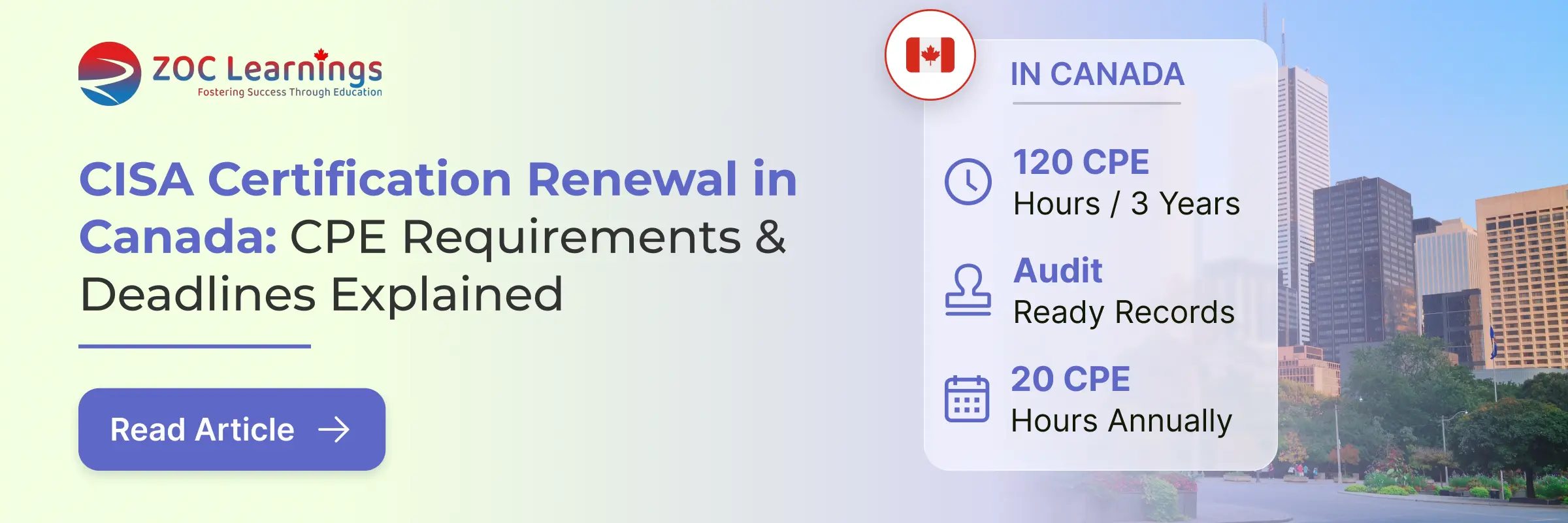
After passing the CISA® exam, Continuing Professional Development (CPD) through ongoing professional education is required to maintain the credential. ISACA does require active CISA holders to complete and report 120 CPE hours during three year periods and at least 20 hours during each year of that period. CISA holders are also required to abide by ISACA’s certification policies and a yearly maintenance fee must be paid as well. CISA is a world-renowned certification credential, so it carries the same requirements for professionals in Canada. (ISACA)
CISA renewal is thus not a three-year venture. You can gain enough CPE hours to count overall and still not meet the minimum requirement hours. Spreading out the cost of CPE courses during the year is a benefit in keeping up your certification and maintaining up-to-date records and avoiding a lapse.
TL;DR:
Active CISA holders are required to complete no less than 20 hours of CPE for each year and 120 hours within a three-year reporting cycle and report the hours completed. CPE activities should be suitable to both the retention and/or enhancement of knowledge or practices for the work of CISA. A yearly maintenance fee is also due, and is currently US$45 for ISACA members and US$85 for non-members. ISACA says the membership fee for maintaining is paid once a year, by January 1 of the following calendar year.
All CPE must be reported in ISACA’s certification management system and all supporting documentation should be kept for audit should it be required. Canadian professionals adhere to the same foundation of CPE as other CISA holders.
The overall 120-hour 3 year requirement and Monthly 20 hour requirement goes unchanged from January 1, 2027. The CPE hours requirement for the three-year cycle is mandatory, but at least 90 of the 120 hours must relate to the specific exam content outline or domain. There are opportunities to contribute hours in other professional development, including leadership, soft skills, mentoring and volunteering, that fit into this category and can be no more than 30 hours.
How many CPE hours are required for CISA renewal?
CISA CPE should contribute to maintaining or advancing knowledge and skills relevant to performing CISA-related tasks. Areas may encompass information systems auditing, information security, IT governance, risk management and controls, assurance and related professional skills.
There are also other providers of education, such as ISACA, that will be accepted for professional education if the activity counts towards the applicable CPE requirement. Courses offered through the IT Audit NOC, cyber security education, Governance & Risk courses or seminars and workshops, university learning with a focus on IT audit, and structured online learning.
Self-study can also be used where it satisfies ISACA requirements, and relevant evidence of such self-study is submitted. This means online learning is valuable for those who are unable to make it to conferences or courses periodically.
What counts as CISA CPE?
Teaching, presenting, and publishing may also be covered by the applicable ISACA rules. Some activities have annual caps to be counted as relevant mentoring and/or as a professional contribution. It is important to review ISACA’s CPE program guidelines before overemphasizing any single CPE activity type.
Work related responsibilities should not be assumed to be CPE all the time. It is important to note that ISACA states that training received during regular work activities and for everyday work productivity is not considered a suitable training qualification, unless a recognised qualifying activity is in effect.
How is one CPE hour calculated?
ISACA typically recognizes participation in a particular professional education program for 50 minutes of activity for every CPE hour (excluding breaks and meals). CPE may be reported in quarter-hour increments (e.g., 20.5 CPE hours).
This does not indicate the number of CPE hours that can be earned, so the number of hours of a conference or course advertised does not necessarily equate with the number of hours for which credit may be applied. Breaks and lunch are not included in the 8 hour event for determining CPE if the event contains breaks and lunch in conjunction with the qualifying action.
Therefore, the retention of the provider’s certificate and agenda/attendance records are of importance. The records can show how reported CPE hours were sourced for an activity in event it should be reviewed later.
CISA renewal deadlines and maintenance fees
There are two areas of CISA maintenance: CPE reporting and payment for the annual CISA maintenance fee. According to ISACA’s latest page on maintenance, the annual maintenance fee must be paid on or before 1st January in order for the certification to be valid for the following calendar year. ISACA members will pay US$45 and non-members will pay US$85. Some fringe benefits for professionals with over two ISACA certifications may include lower fees for additional certifications.
Poor CPE reporting such as annual reporting which starts January 1st. It is strongly advised that CISA holders do not wait until end of December to submit their CPEs but that they ensure that their MyISACA records are kept up-to-date throughout the year.
From September, ISACA will be starting to notify of inv/2015. Therefore, reviewing the certification dashboard before the end of the year may be a good way to take stock of unpaid fees and/or missed CPE before a problem arises.
A basic planning approach is to accomplish about 5 CPE hours each quarter. The 20 hour minimum is not a requirement from ISACA but is a reasonable means in which to get the 20 hours needed without having to rely on a single course or conference towards the end of the year.
Can CISA training count toward CPE?
Structured training may be an effective means to incorporate professional development while satisfying the requirements for continuing professional education (CPE) maintenance. The options which may be relevant include CISA related refresher course, IT audit and assurance training, information security and controls courses, and governance and risk education and structured online learning.
Non-ISACA education can be qualified to earn when furthering of the knowledge or skills associated with the CISA credential. But not all training hours are automatically “CPE” and those a commercial course includes must be counted as CPE. A professional should review the CPE CPD designed by a provider to ensure it is relevant and have on hand the evidence of the completion of the CPE CPD or any supporting documentation that the provider has provided.
CISA structured training may also be used to prepare for the CISA exams for professionals who are seeking it for the first time. Existing CISA awardees can expect to get refresher training and professional development from relevant training.
ZOC Learnings offers CISA certification courses in topics related to an information systems audit, governance, controls and security to professionals outside of Canada and online.
CISA certification renewal for Canadian professionals
The CISA certification renewal process in Canada is structured around ISACA’s international (global) maintenance process. The ISACA requirements for CPE do not differ from the normal requirements that apply to anyone working in the field; there is no specific Canadian rule to substitute this. Thus, Canadian CISA holders will have to adhere to both the 20-hour per year and the 120-hour per three-year requirement, payment of the applicable maintenance fee, and other certification requirements. (ISACA)
For Canadian professionals, the key to finding CPE that is relevant is to select a convenient source. ISACA’s Canadian chapter network can provide opportunities for professional education, seminars, workshops and other events. Employer-sponsored training and whilst online courses, conferences and other relevant learning activities may be considered as well.
It is especially beneficial for CISA holders in internal audit, cyber security, IT risk, compliance or governance careers and is a value for the employer. It is prudent to verify the relevance of the training to CISA related knowledge and/or skills, and the documentation of the training activity and the number of hours required for the activity.
For those who work out of the major Canadian centres, or have busy-lined jobs, online learning can be particularly convenient. Prior to enrolling, ensure that the course is relevant, the number of CPE hours it offers is acceptable, and that there is documentation for completion and compatibility with ISACA’s current CPE policy.
Need structured CISA training for professional development? ZOC Learnings offers CISA certification training in canada with online learning options for professionals in Canada and the US.
Important CISA CPE changes from 2027
Those who wish to renew in the future should focus on CISA’s updated CPE policy that will come into effect on January 1, 2027.CISA members who are interested in renewing in the future should be aware of the changes in the CPE policy that will go into effect on January 1, 2027.
The basic requirement does not increase. Experienced professionals will require at least 20 hours of continuing professional education (CPE) per year and 120 hours of CPE every 3 years. The significant modification is on the hours of registration. No less than 90 of the 120 hours shall relate to the exam content outline or domain of the certification. As many as 30 hours can be spent on a more general professional development.
Professional development can involve broad areas including soft skills (communication and other soft skills), leadership, business skills, mentoring and volunteering. Certification-aligned activities may involve technical education, conferences or other content development options relating to the CISA domain and/or the exam content outline.
From 2027 forward, it becomes crucial for CISA holders to plan for continuing professional education (CPE). Having records that make it easy to report back into a course/activity and demonstrate how it aligns to the CISA domain.
ISACA has also announced that total CPE point usage for ISACA certified professionals affected by the changes in the 2027 won’t be increased. New changes to the policy focus on how CPE can be categorized—not necessarily on expanding the overall burden of CPE.
What records should CISA holders keep?
The reason CPE documentation is crucial is that ISACA might choose to auditt the certification holders every year to verify that they are current with their CPE hours. As evidence to support, certificates of completion, attendance records, letters from training providers, Verification of Attendance forms and other independent documentation can be used.
There should be enough detail in the records to identify the sponsoring organisation, the activity, description, date and number of CPE hours awarded and/or claimed. ISACA’s latest CISA maintenance guidelines say document needs to be kept for 12 months after the end of 3 reporting periods. (ISACA)
A solution is to have a Learners Workbook folder per CPE year in a digital format. Immediate certificate saving will minimize any risk of losing evidence or having to piece together CPE certificates when it comes time to report.
What happens if CISA renewal requirements are missed?
fail to meet maintenance requirements as required by CISA, your certification may go in limbo. This may include non-fulfillment of CPE requirements as well as the failure to pay the applicable maintenance fees for certification, and failure to fulfill the certification requirements.
A CISA may be revoked due to CPE failure and the professional may appeal for its reinstatement. ISACA says that an approved appeal will have outstanding certification maintenance fees, and a US$50 appeal fee, due and payable. Failure to approve the appeal will mean you need to retake and pass the CISA examination and resubmit a new certification application with the correct experience.
This will make it so much easier to keep track of your CPE than having to deal with certification expiration due to revocation.
Non-Practicing and Retired CISA status
ISACA offers two Non-Practicing and Retired statuses for those who have attained a CISA. Non-Practicing may refer to past professionals who may reenter the information systems audit, control or security profession. In this status, yearly continues and there is no requirement for yearly CPE, but there is an annual maintenance fee.
There are different qualifications for retiring. ISACA states that it can be considered by persons 55 or older who are permanently retired from their profession and for some, persons not able to undertake duties relevant to their profession because of a permanent disability. For retired employees, being retired waives the CPE and annual maintenance fees.
Both candidates and existing ISACA professionals are urged to check the current criteria and application guidelines for status change as this may impact the use of the CISA designation.
CISA certification renewal checklist
CISA holders must check each year before year end that they submitted at least 20 of CPE hours and that the activities are relevant, that the supporting certificates were stored and that the total of the 3-year period is at least 120 hours.
Check the annual maintenance fee in certification dashboard. For those looking ahead to 2027 or beyond, the domain or exam content outline of the CISA exam can be used to consider the CPE, so that 90 of the 120 hours available each year will satisfy the CISA exam content outline or domain.
Conclusion
Renewing CISA is a continuous maintenance process and not something that you can wait until the end of the 3-year cycle to complete. Active CISA holders need at least 20 CPE hours each year, 120 CPE hours over the applicable three-year reporting period and the required annual maintenance fee. Canadian professionals use the same world-wide ISACA framework.
The simplest solution to renewing is to put CPE on the regular professional growth schedule. Educational activities like training, conferences, online, employer education initiatives, and other approved activities may be spread across the year. In addition, beginning in 2027, all professionals must complete at least 90 hours of their CPE over the past three years that are consistent with the CISA exam content outline (ECO) or CISA domain.
If structured learning is desired, then training that aligns with the CISA theme and will help develop relevant knowledge may also help give professionals a way to continue their professional education.
Looking for structured CISA training? Explore ZOC Learnings’ CISA certification training for working professionals in Canada and the US.
FAQ
How many CPE credits are required to renew CISA?
CISA holders are required to accumulate and report 120 hours of CPE in three years, and meet at least 20 hours of CPE annually. Each activity should be related to the maintenance or advancement of knowledge and skills of current and future CISA duties.
When is the CISA renewal deadline?
CISA maintenance is positioned in a yearly reporting process. ISACA is stating that the annual renewal is for the next calendar year on January 1. Professionals should get their CPE done well in advance of the end of the reporting year.
What activities count as CISA CPE?
Eligible activities can involve professional education, conferences, seminars, online learning, self-study, teaching, publishing, mentoring and some professional contributions. Prior to reporting hours, the on-going ISACA CPE policy should be reviewed given activity-specific limits may apply.
Are CISA renewal requirements different for Canadian professionals?
No. Canadian CISA holders will comply with ISACA’s global maintenance requirements which include ISACA’s 20 hour minimum per year, the 120 hour requirement every 3 years and applicable annual maintenance fee.
What is the CISA annual maintenance fee?
The current fee is US$45 for ISACA members and US$85 for non-members. Discounted fee is available for some professionals who have two or more ISACA certifications.
Can online training count toward CISA CPE?
Yes. Time spent in relevant structured education through online courses or self-study courses is qualifying if it fulfills ISACA’s criteria. It is the professional’s responsibility to confirm the CPE hours earned and keep proper proof of completion.
What are the CISA CPE changes in 2027?
From January 1, 2027, the annual 20-hour and three-year 120-hour requirements remain unchanged. At least 90 of the 120 hours must align with the certification’s exam content outline or domain, while up to 30 hours may come from broader professional development.
What happens if CISA CPE requirements are not completed?
Non-compliance can result in revocation of the CISA credential. Depending on the circumstances, reinstatement may require an appeal, payment of outstanding fees and a US$50 reinstatement fee. If reinstatement is not approved, retaking the CISA examination and submitting a new certification application may be required.
Can Canadian CISA holders earn CPE through ISACA chapters?
Yes. Relevant events, seminars and/or ISACA education provision in the relevant chapter may provide sources of CPE. Each CPE activity must be confirmed by an expert with a documentation of attendance/completion, and the value of the CPE should be preserved with each activity.