Key Takeaways:
PgMP certification in 2026 focuses on strategic program leadership, multi-project governance, and business value delivery.
- It is designed for experienced professionals managing multiple related projects aligned with organisational goals.
- Eligibility requires significant program management experience along with formal education and structured application validation.
- PgMP validates the ability to manage complexity, align strategy, and drive large-scale outcomes beyond individual projects.
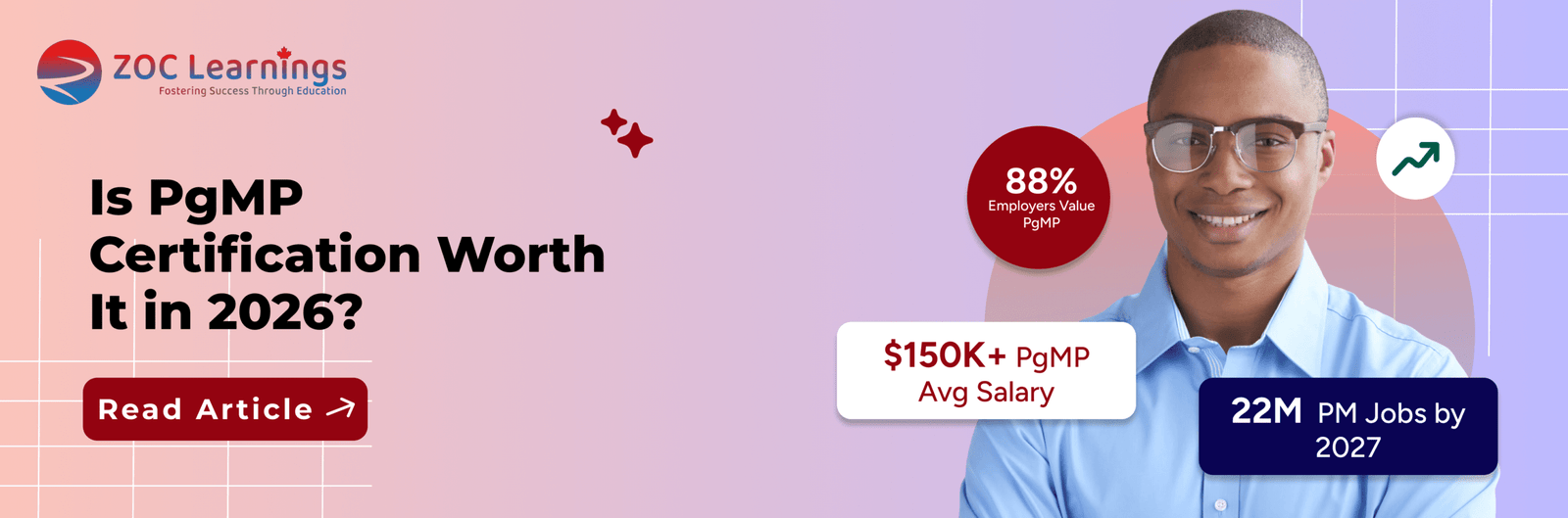
Is PgMP Certification Worth It in 2026?
The PgMP (Program Management Professional) certification continues to hold strong value for senior professionals in 2026. As organisations increasingly manage complex initiatives across multiple projects, the need for skilled program managers has grown significantly.
PgMP is not just about managing tasks — it focuses on aligning projects with business strategy, ensuring benefits realisation, and leading large-scale transformations.
Understanding its relevance is essential before investing time and effort into this advanced certification.
What is PgMP Certification (2026)?
PgMP is a globally recognised certification offered by PMI for professionals who manage multiple, related projects as a program.
It is designed for leaders who:
- Oversee multiple projects simultaneously
- Align outcomes with organisational strategy
- Manage stakeholders at senior levels
- Ensure long-term business value delivery
Unlike PMP, which focuses on individual projects, PgMP operates at a higher strategic level.
PgMP vs PMP: Understanding the Difference
Here is the properly formatted table:
Heading | PgMP | PMP
Role | Program manager | Project manager
Focus | Strategy & multiple projects | Individual project execution
Scope | Enterprise-level impact | Project-level delivery
Strength | Strategic alignment | Execution excellence
Limitation | Requires extensive experience | Limited to project scope
Both certifications are valuable, but they serve different career stages.
PgMP Certification Requirements (2026)
PgMP eligibility is structured and requires strong professional experience.
- Educational Qualification
• Bachelor’s degree (or equivalent):
Requires 48 months of project management experience + 48 months of program management experience
- High school diploma or equivalent:
Requires 48 months of project management experience + 84 months of program management experience
- Program Management Experience
Candidates must demonstrate:
• Experience managing multiple related projects
• Strategic alignment with business goals
• Leadership across program lifecycle
• Non-overlapping experience within a defined timeframe - Application & Panel Review
• PgMP applications go through a detailed review process
• Includes evaluation by a panel of experts
• Requires clear documentation of program experience
This ensures only experienced professionals qualify.
Why PgMP Certification Matters in 2026
The business environment is becoming more complex and interconnected. Organisations are shifting from isolated projects to integrated programs.
PgMP certification helps professionals:
- Handle large-scale business transformations
- Align projects with long-term strategy
- Improve governance and risk management
- Deliver measurable business outcomesBuild credibility at senior leadership levels
When is PgMP Worth It?
PgMP is valuable if you:
- Manage multiple projects or portfolios
- Work in senior leadership or strategic roles
- Aim to move into executive-level positions
- Handle cross-functional or enterprise-wide initiatives
However, it may not be suitable if you are early in your project management career.
Career Benefits of PgMP Certification
PgMP-certified professionals often gain:
- Higher credibility and recognition
- Opportunities in senior leadership roles
- Better salary potential
- Global career opportunities
- Stronger strategic decision-making skills
It positions professionals as leaders who can manage complexity, not just execution.
Challenges to Consider
Before choosing PgMP, it is important to understand:
- It requires extensive experience and documentation
- The application process is rigorous
- Preparation demands strong conceptual clarity
- It is not an entry-level certification
This makes PgMP a serious commitment.
How to Apply for PgMP Certification
The application process is structured and detailed.
- Create an account on the PMI website
- Fill in project and program experience carefully
- Submit the application for panel review
- Wait for approval
- Schedule and take the PgMP exam
If selected for audit, candidates must provide supporting documents.
Keep in Mind
- PgMP is designed for senior professionals
- Accuracy in application is critical
- Experience matters more than job title
- Preparation should focus on strategy and governance
- Requirements may evolve with industry needs
Conclusion
PgMP certification in 2026 is highly valuable for experienced professionals aiming for strategic leadership roles.
It may not replace PMP, but it builds on it by expanding scope from project execution to program-level impact.
For professionals managing complex initiatives and aiming for executive growth, PgMP is not just worth it — it can be a defining step in their career.
Frequently Asked Questions (FAQs)
- Is PgMP certification worth it in 2026?
Yes, it is highly valuable for experienced professionals managing multiple projects and aiming for leadership roles. - What is the difference between PgMP and PMP?
PMP focuses on project execution, while PgMP focuses on managing multiple projects aligned with strategy. - Who should apply for PgMP?
Senior professionals with program management experience and leadership responsibilities. - Is PgMP difficult to obtain?
Yes, it requires significant experience and a rigorous application and review process. - Does PgMP increase salary?
It can improve earning potential due to its focus on senior and strategic roles.

Darrshan Kaur
Global COO of ZOC Group with 18+ years of experience driving business growth across Canada, UAE, USA, and India. She specializes in strategic partnerships, Agile transformation, and cybersecurity consulting, helping tech leaders build strong leadership presence and achieve measurable ROI.